
Standard precautions are the minimum infection prevention measures applied to every patient[1][2], in every healthcare setting, at every care interaction — regardless of whether the patient is known or suspected to have an infection. They protect both patients and healthcare workers from cross-transmission.
Components of standard precautions
| Component | Key actions |
|---|---|
| Hand hygiene | WHO 5 Moments; ABHR at point of care; soap and water when visibly soiled or after C. difficile contact |
| Personal protective equipment (PPE) | Gloves, gown, mask and eye protection selected based on anticipated exposure — not applied uniformly to all contacts |
| Respiratory hygiene and cough etiquette | Cover mouth/nose when coughing; use tissues; dispose immediately; perform hand hygiene; apply to all persons in the facility including visitors |
| Safe injection practices | One needle, one syringe, one patient; never re-use; dispose into sharps container immediately after use |
| Safe handling of potentially contaminated equipment | Handle soiled equipment in a manner that prevents transfer; reprocess per Spaulding classification (Decree N185) |
| Safe handling of healthcare waste | Segregate at source; dispose per Decree N294 |
| Environmental cleaning | Regular cleaning and disinfection of high-touch surfaces; enhanced cleaning in outbreak situations |
| Patient placement | Place patients who may contaminate the environment in single rooms when possible; apply spatial separation when single rooms not available |
| Safe handling of linen | Handle soiled linen without shaking; contain and transport in impermeable bags; launder at 60–90°C |
PPE selection guide
| Clinical activity | Gloves | Gown | Surgical mask | Eye protection |
|---|---|---|---|---|
| Routine patient contact (intact skin) | Not required | Not required | Not required | Not required |
| Contact with blood, body fluids, mucous membranes | ✓ Required | If splash risk | If splash risk | If splash risk |
| Wound care, catheter insertion, IV access | ✓ Required | If splash risk | Not required | Not required |
| Procedures generating aerosols or splashes | ✓ Required | ✓ Required | ✓ Required | ✓ Required |
| Cleaning contaminated surfaces or equipment | ✓ Required (heavy duty) | ✓ Required | Not required (unless spray) | Not required (unless spray) |
ASF Patient-Safety Posters — Free, Print-Ready (A4) · Keep the ASF mark
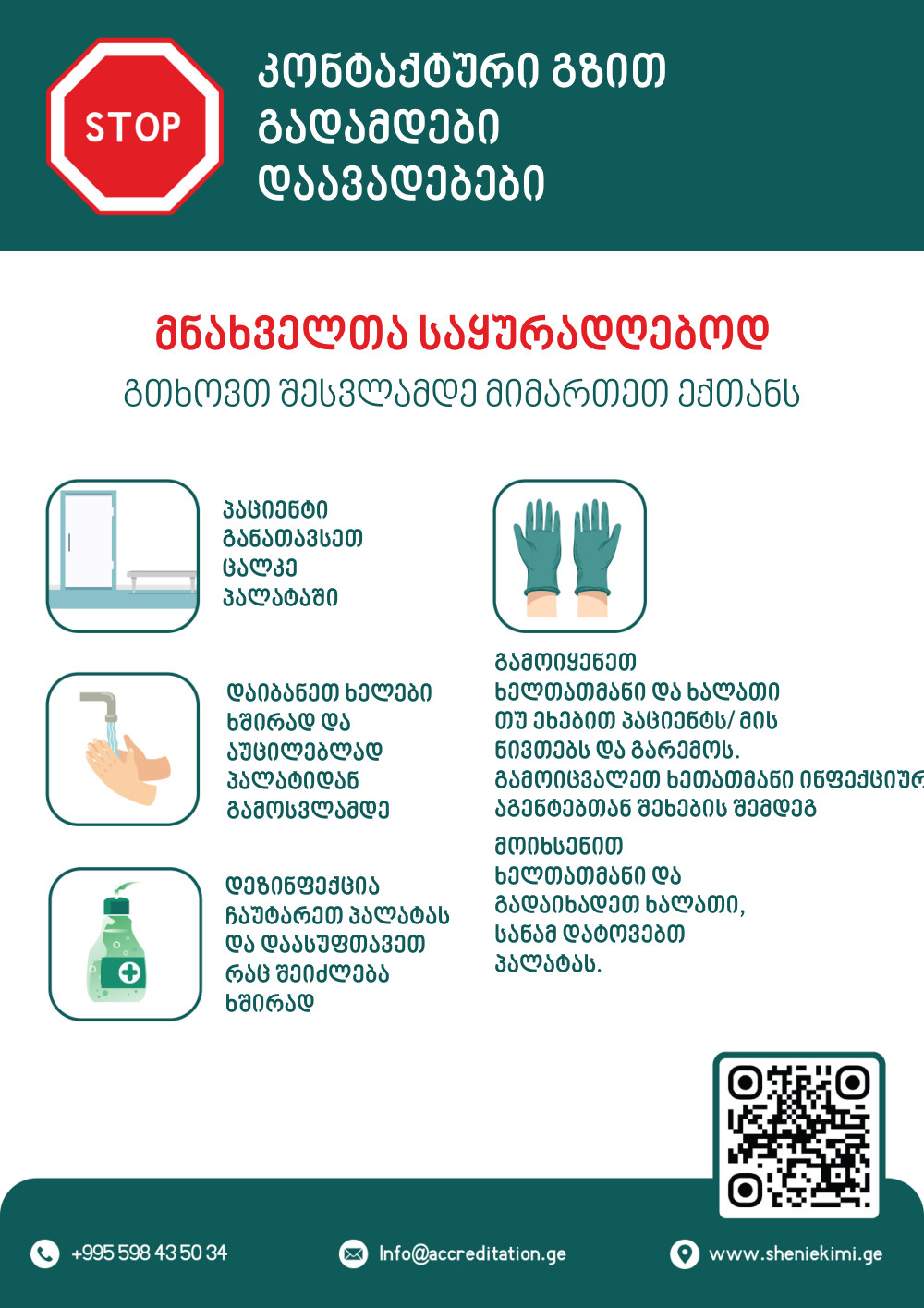
Free for any facility to print and display · Full poster library at france-asf.fr/posters/
Georgian original source / ქართული წყარო
Standard Precautions — WHO IPC Core Components
References
- [1] WHO. Guidelines on Core Components of Infection Prevention and Control Programmes at the National and Acute Health Care Facility Level. World Health Organization. 2016;—:—. Available at: https://www.who.int/publications/i/item/9789241549929
- [2] Siegel JD, Rhinehart E, Jackson M, Chiarello L; Healthcare Infection Control Practices Advisory Committee. 2007 Guideline for Isolation Precautions: Preventing Transmission of Infectious Agents in Healthcare Settings. Am J Infect Control. 2007;35(10 Suppl 2):S65–S164. doi:10.1016/j.ajic.2007.10.007
- [3] Ministry of IDPs, Labour, Health and Social Affairs of Georgia. Order N01-268/o on the National Infection Prevention and Control Programme. MoLHSA Georgia / Matsne. 2016;—:—. Available at: https://matsne.gov.ge/ka/document/view/3293056
- [4] Pratt RJ, Pellowe CM, Wilson JA, et al. Epic2: National evidence-based guidelines for preventing healthcare-associated infections in NHS hospitals in England. J Hosp Infect. 2007;65 Suppl 1:S1–64. doi:10.1016/j.jhin.2006.10.002
 Published by the Public Health Institute of Georgia (PHIG) · IPC Resources Library · Contact PHIG
In plain language
Standard precautions are the basic infection control practices applied to every patient, whether or not an infection is known: hand hygiene, protective equipment according to risk, respiratory hygiene, safe injections, cleaning and safe handling of equipment, linen and waste.
Why it matters
Key actions checklist
- Hand hygiene at the five moments
- Gloves, gowns, masks and eye protection according to anticipated exposure
- Respiratory hygiene and cough etiquette
- Safe injection practices and sharps disposal
- Routine environmental cleaning
- Safe handling of linen and waste
International guidance
- WHO Guidelines on core components of IPC programmes (2016)
- WHO Global report on infection prevention and control (2022)
Questions and answers
Why apply them to every patient?
Many infections are not yet diagnosed when care begins; treating everyone the same protects patients and staff.