Tbilisi, 6 October 2026 — PHIG analysis. Three developments reported this week by Devex, the development news service, describe a global health financing system that is contracting and re-sorting itself — and each of them lands on Georgia and the countries around it in a specific way. The Public Health Institute of Georgia sets out what they mean from a Georgian and regional perspective, and what the region should do about it.
What is happening
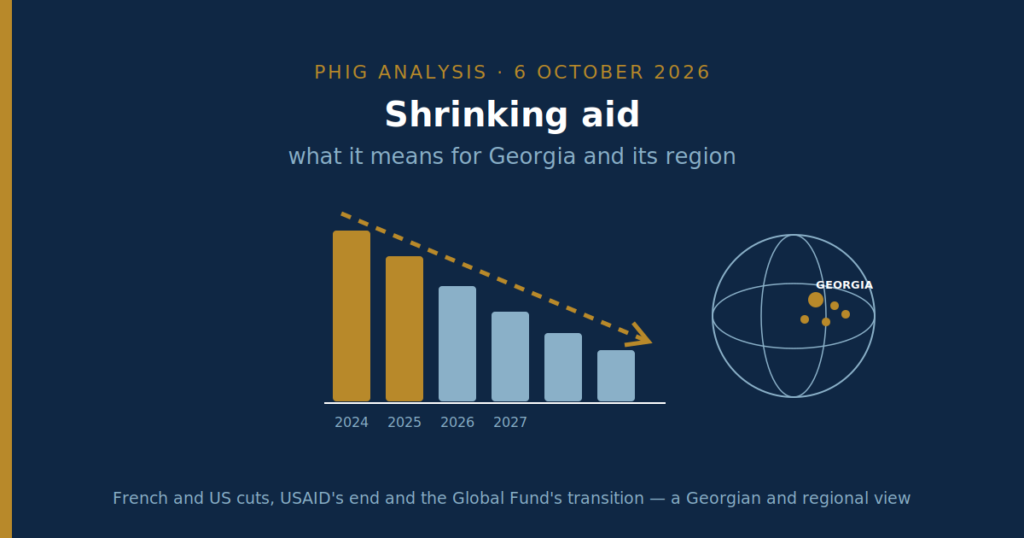
France is cutting again. According to Devex, the French government proposes to reduce official development assistance from about €3.6 billion in 2026 to roughly €3.2 billion in 2027, and to cut by €1.9 billion the appropriations it can commit to future projects — after cuts of 12.5% in 2024, 37% in 2025 and 18% in 2026. French aid experts quoted by Devex expect closures of health centres and of projects on gender-based violence and climate; a study by Coordination SUD and CartONG, cited in the same report, attributes 15 million people affected and 10,000 jobs lost to the earlier cuts.
The United States spent its money at the last minute — and kept some for closing USAID. Devex reports that the State Department obligated more than $4 billion of foreign aid in the week before 30 September, mostly for global health, largely without competition, and that some $2.5 billion is reserved for winding down USAID rather than for the programmes Congress intended. Bilateral health deals of the kind just concluded with Zambia — 35 signed so far — are becoming the US instrument of choice; in Zambia’s case, the government says conditions on access to minerals and on sharing pathogen samples were dropped before signature.
The Global Fund is choosing a new leader and a narrower map. With its executive-director shortlist announced, Devex notes the Fund has already decided to direct a greater share of resources to lower-income, high-burden countries, with several middle-income countries receiving their final allocations over the current and next grant cycles. A former New York City health commissioner argued in Devex that the Fund should move from financing disease-specific interventions to building health systems.
Why this is a Georgian and regional story
- Georgia and most of its neighbours are the middle-income countries being graduated. The Global Fund’s policy of final allocations for middle-income countries is exactly the category Georgia, Armenia, Azerbaijan, Moldova and Kazakhstan fall into. For HIV and tuberculosis — where Georgia’s programmes were built with Global Fund money and where the region still has among the highest rates of multidrug-resistant TB in the world — “transition” means the state budget must carry what donors carried, including procurement, laboratory quality and the civil-society services that reach key populations. The next Fund leader’s position on country transition will matter more to Tbilisi, Chișinău and Yerevan than the leader’s name.
- USAID’s closure removed the region’s most visible health partner, and the replacement model is bilateral and transactional. USAID programmes in Georgia — on health-system strengthening, TB, HIV and primary care — ended with the agency in 2025. The new US instrument is a government-to-government deal with conditions negotiated case by case. Small countries negotiating alone, as Zambia did for months, have weak leverage; the Zambian experience shows that terms on data, samples and resources can be put on the table and must be read in full by parliaments before they are signed.
- France matters to the Caucasus more than the headline suggests. The Agence Française de Développement is active in Georgia and Armenia; French funding reaches the region also through the EU budget, Expertise France and francophone academic links. Cuts to commitment appropriations hit future projects first — precisely the pipeline the South Caucasus was counting on for climate-and-health, primary-care and gender-based-violence work.
- The European Union becomes the anchor by default — with conditions. With US and French bilateral funding shrinking, the EU, EU4Health, Horizon Europe and the enlargement instruments are the largest remaining source for Georgia and Moldova as candidate countries. Access to them depends on governance, transparency and policy compliance that institutions must be able to demonstrate — the reason PHIG published its full policy framework this autumn.
- Health security does not wait for budgets. The same week brought a suspected plague death at a Russian research institute, which WHO is still verifying and currently assesses as low public health risk, and the spread of Ebola from the Democratic Republic of the Congo to Nairobi. Georgia’s borders, migration routes and laboratory capacity make surveillance and workforce competence — not only money — the decisive variables.
PHIG’s position
“The lesson of this week is that the region can no longer plan around donors. Georgia has the physicians; what it must now fund itself is the laboratory quality, the TB and HIV services for people the state does not easily reach, the competence of its primary care workforce, and honest surveillance. Transition should be planned in the open, with parliament seeing every agreement in full — including any bilateral health deal — before it is signed. And the countries of the Caucasus and Central Asia should negotiate together where they can: a regional position on transition, on data and sample sharing, and on EU access is worth more than five separate ones.”
— Prof. Giorgi Pkhakadze, Chair, Public Health Institute of Georgia
What PHIG proposes
- A public transition register for Georgia: every donor-funded health service, the date support ends, and the budget line that replaces it — compiled with the Ministry and published on this site.
- A regional working paper on Global Fund transition in the South Caucasus and Moldova, through the Georgian Medical Journal, as the first output of the regional health policy research agenda.
- Parliamentary disclosure as a principle: any health financing agreement that commits Georgian co-financing or data should be published in full before signature.
- Investment in the two things donors cannot withdraw: workforce competence and open, sourced evidence.
Sources
- Devex, “An update on the US-Zambia health deal, and notes for the next Global Fund leader”, newsletter by Jenny Lei Ravelo, 6 October 2026 (web version), reporting by Jesse Chase-Lubitz, Elissa Miolene and Andrew Green; study by Coordination SUD and CartONG as cited there.
- Global Fund, Sustainability, transition and co-financing policy.
- Agence Française de Développement, AFD in Georgia.
- WHO, Disease Outbreak News (Ebola, DRC; suspected plague, Russia — verification pending).
Figures on French and US budgets are as reported by Devex and are not independently verified by PHIG. Media contact: info@accreditation.ge. This analysis may be quoted with attribution to the Public Health Institute of Georgia and a link to this page.

Public Health Institute of Georgia