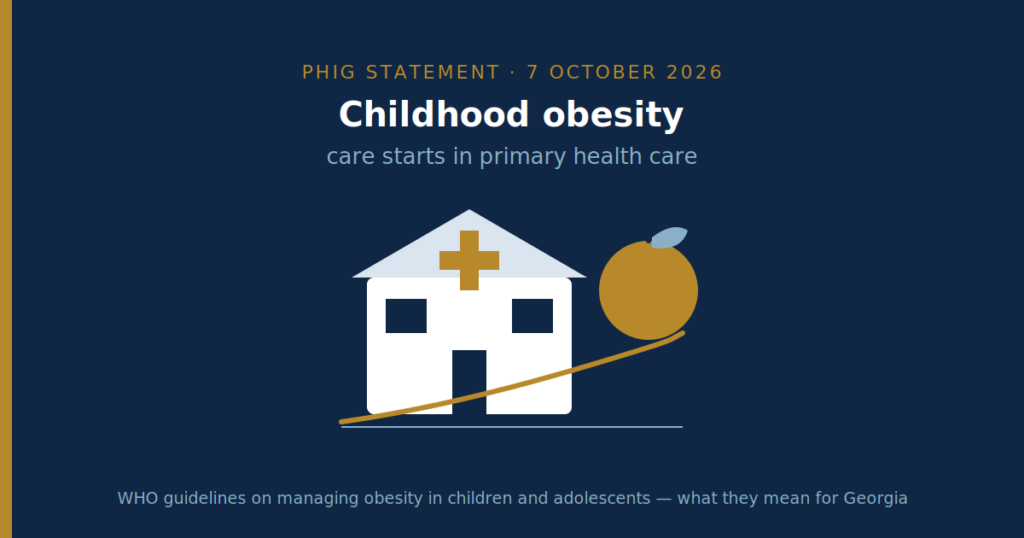
Tbilisi, 7 October 2026 — PHIG statement. The World Health Organization today publishes its guidelines on the integrated management of obesity in children and adolescents through primary health care, following an embargoed press briefing held on 6 October. The Public Health Institute of Georgia welcomes the guidelines and sets out below what they mean for Georgia and the region.
What WHO has published
WHO has been developing these guidelines since 2021 through two Guideline Development Groups — one for children, one for adolescents aged 10 to 19 — with public consultation on the adolescent draft in April 2026. Their stated aim is to give countries clear, adaptable clinical and public health recommendations on managing obesity in children and adolescents in primary care, covering family- and community-based interventions, diet, physical activity and behavioural support, and the place of pharmacological and surgical options, grounded in equity and human-rights principles. The guidelines complement WHO’s existing prevention guidance and respond to the stalled progress on childhood overweight recorded in WHO’s global targets. The full text and press materials are available from WHO from 7 October; PHIG will add the links to this page as they are released.
PHIG comment
Prof. Giorgi Pkhakadze, Chair of the Public Health Institute of Georgia:
“These guidelines matter for Georgia for a simple reason: they put the management of childhood obesity where families actually go — primary health care — rather than in specialist clinics that most children never reach. Georgia takes part in WHO Europe’s Childhood Obesity Surveillance Initiative, so we know the problem exists; what we have lacked is a clinical and public health pathway that a family doctor, a nurse and a school can follow together.
“Three things will decide whether the guidelines change anything here. First, competence: a guideline is only as good as the primary care workforce trained to use it, and our observatory’s evidence shows that Georgia’s challenge is skill mix and competency, not the number of doctors. Second, the food environment: management in the clinic cannot succeed against marketing, school meals and pricing that push children the other way, so the guidelines must be read together with the prevention measures Georgia has already committed to. Third, honesty with families: children with obesity must be treated with dignity and without blame, and parents must be protected from the weight-loss supplements and quick cures that our product-science laboratory sees marketed every week.
“PHIG will translate the guidelines’ key recommendations into Georgian, offer a free course for primary care teams through GMJ Academy, and work with the Ministry, the NCDC and the medical universities on an adaptation for Georgia.”
What PHIG will do
- Publish a Georgian summary of the recommendations once the full text is released, with the source and date stated.
- Open a GMJ Academy course for primary care doctors and nurses on the management of childhood obesity, built on the WHO text.
- Add childhood obesity management to the PHIG research agenda under Epidemiology and NCDs, and invite Georgian researchers to study implementation in primary care.
- Through Sheni Labs and SupplementIndex, continue to assess weight-loss products marketed to parents and children in Georgia against the published method.
Sources
- WHO Media, “Embargoed virtual press briefing on the launch of the child and adolescent obesity guidelines”, 6 October 2026 (embargo lifted 7 October 2026).
- WHO, Call for public comments — WHO guidelines on the integrated management of obesity in adolescents, 10 April 2026.
- WHO, Call for experts: Guideline Development Group on treatment of children and adolescents with obesity.
- WHO Regional Office for Europe, Childhood Obesity Surveillance Initiative (COSI).
Media contact: info@accreditation.ge. This statement may be quoted with attribution to the Public Health Institute of Georgia and a link to this page. It is not individual medical advice.

Public Health Institute of Georgia